
Behind the Scenes of Smooth Flow with Daniel Kohli
Daniel Kohli, Head of Product Development at KNF’s Product Center for liquid pumps, provides exclusive insights into our low pulsation pumps.

With the development of Smooth Flow pumps, KNF reduced pulsation in liquid diaphragm pump systems to a minimum, setting new standards in diaphragm pump technology. In this interview, Daniel Kohli, Head of Product Development at KNF Flodos, our Product Center for liquid pumps, shares exclusive insights on the development process, technology, and key benefits for customers. He also tells us about the newest innovation project: KNF’s first pump with intelligent features.
Why did you see a need for low pulsation pumps?
At KNF, we want innovations to provide the most added value to our customers. This is why we develop and produce robust and flexible product platforms that can be tailored to the customer and application requirements. During an innovation workshop we looked at pain points within the market. Two factors stood out and drove the need for the development of our Smooth Flow pumps: First, like all positive displacement pumps, diaphragm pumps generate pulsation. We wanted to eliminate this disadvantage through our technological leadership. Second, there was a strong demand in the digital printing market for a pump with a flow rate of 4 l/min and very low pulsation, and a customer from Italy was requesting this solution.
How do Smooth Flow pumps work?
Before I explain our Smooth Flow technology, I first need to explain pulsation. In liquid diaphragm pumps, a membrane is moved up and down by an eccentric. The downward stroke causes the liquid to be drawn in, and the upward stroke pushes it out. This happens about 50 times per second during nominal operation and causes stop-and-go movement of the liquid on both the inlet and outlet side, which is called flow pulsation. Resistance in a customer’s system through tubing, screens, or filters can cause the flow pulsation to create pressure pulses that can reduce the lifetime of both the pump and the customer system.
The Smooth Flow technology used in our FP pumps reduces pulsation in liquid transfer systems to a minimum. We achieve this through two different approaches:
Smooth Flow pumps like the FP 150 and FP 400 are designed with five diaphragms that are connected in parallel. Each membrane operates at the same speed, but with a phase shift of one fifth relative to the next diaphragm. This results in the stop-and-go movement occurring five times more frequently with five times smaller stroke volumes and reduces pulsation by a factor of approximately ten.
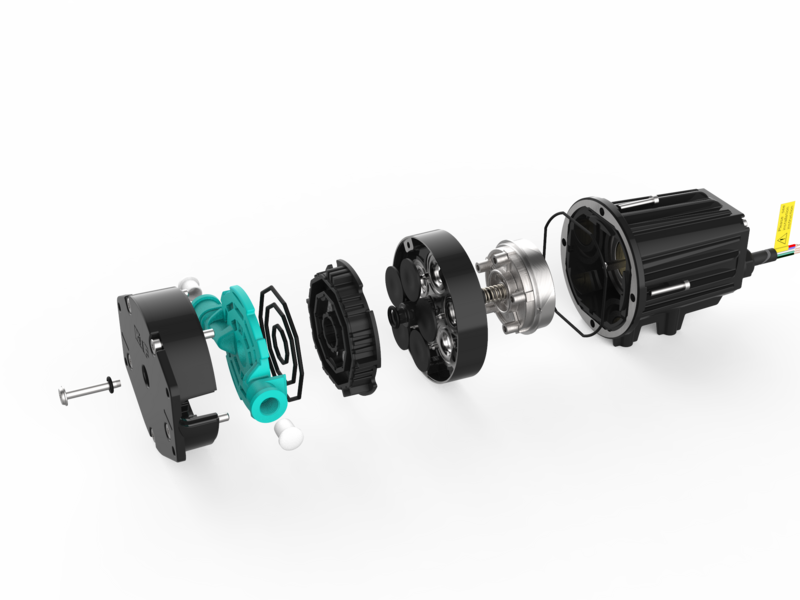
In our smaller FP pumps like the FP 7, FP 25, or FP 70, we integrated passive damper elements on the inlet and outlet side of the pump. During the discharge process, the damper on the outlet side stores part of the liquid and expels it during the suction process. This concept reduces pulsation by a factor of approximately 100, and special designs have even reduced pressure pulsation in the customers’ system to less than 1 millibar. This is a milestone in the history of diaphragm pumps!

What advantages do Smooth Flow pumps offer?
Pulsation has been a pain point for certain liquid transfer applications with the otherwise outstanding diaphragm pump technology. Benefits of diaphragm liquid pumps include self-priming and dry-running ability, high media resistance, minimal maintenance requirements and leakage-free as well as clean operation. The Smooth Flow technology combines this with low pulsation and gives the FP pumps a massive advantage compared to other liquid transfer systems such as gear pumps. Customers benefit from a steady flow rate with low pulsation which reduces noise and vibrations to a minimum. I am still impressed by how quiet our multi-diaphragm pumps operate.
Additionally, the constant and predictable flow reduces pressure peaks generated by resistance in the customer system. This not only leads to a longer service life of the pump, but for the entire system and its components, ultimately increasing the Overall Equipment Effectiveness (OEE) of the customer system.
Which industries benefit from low pulsation pumps?
Originally, we saw a high potential for the Smooth Flow Technology in digital printing such as Drop-on-Demand (DoD) and Continuous Inkjet Printing (CIJ) which has been confirmed. But now I see that customers across all industries highly benefit from our FP pumps. This includes, for example, medical devices, laundry washing and laboratory equipment.
Can you describe a specific use case where KNF Smooth Flow pumps make a difference?
I can share a use case in digital printing that uses a customized FP pump. In digital printers, tiny droplets are ejected from a print head and combined to form a high-resolution print product, for example a poster. To ensure that these droplets are delivered in a consistent quality, the ink must be transported to and from the print head without pulsation. The print head is often supplied with a pressure-over-liquid transfer system which is quite complex and costly, because it requires additional components to ensure a smooth recirculating flow and stable vacuum. By using a customized Smooth Flow pump, we can meet the very strict pulsation requirements without having to install additional components for pulsation damping. This allows our customers to design a more cost-effective and simpler inkjet printing system. If you want to gain more insights into advancements in ink delivery systems, you can read our blog Pumps for Drop-on-Demand Digital Inkjet .
Looking back, did Smooth Flow have a positive impact on future development projects?
Absolutely. I realized that the targeted use of simulation tools to design, for instance, pulsation dampers or drives, significantly accelerates product development. We used, for example, a proprietary tool developed by my colleague Raphael Frey for modeling hydraulic systems, along with additional tools for nonlinear finite element analysis, computational fluid dynamics (CFD), and bearing calculations. Our prototypes are still being tested in numerous experiments, but the simulations allow us to explore the limits and determine whether something will work before we even start prototyping.
In addition, early customer sampling was very valuable. Seeing how our prototypes operate in an existing application allowed us to have an engineer-to-engineer exchange where we gained in-depth application knowledge. This enabled us to incorporate the corresponding customer requirements directly into the product development. Collaborations like these require a great deal of trust on both sides and we are not taking it for granted. This is based on long-standing relationships with our customers, which have been further strengthened as a result.
From an innovation perspective: Why is Smooth Flow important?
It paves the way to our first pump with intelligent features. By reducing pulsation in liquid transfer systems to a minimum, we reached a milestone in diaphragm pump technology. Now we want to push the boundaries even more and want to enable our customers to specify and set the desired flow rate themselves. The technology we are currently developing combines our FP pumps with sensors, enabling it to regulate the flow rate automatically – even under changing environmental conditions such as pressure or temperature. The combination with a sensor is only possible thanks to the significant reduction in pulsation achieved by our Smooth Flow pumps. With standard diaphragm pumps, the pulsation would be too high to measure the flow rate.
Does the development of Smooth Flow reflect KNF’s approach to innovation?
At KNF, an innovation is more than just an outstanding technical solution. Only when the product offers our customers tangible added value do we consider it to be a genuine innovation. I firmly believe that we achieved this with our Smooth Flow pumps, because the huge reduction in flow pulsation has redefined the limits of diaphragm pump performance.