

Why Safety Diaphragm Pumps Ensure Leak-Tightness in Demanding Environments
Using a safety diaphragm ensures a leak-tight and contamination-free pump operation to fulfill highest safety requirements even in the unlikely event that the working diaphragm fails.

Very demanding environments in chemical or pharmaceutical processes and the transfer of hazardous, toxic, or valuable media place high safety standards on the used systems. Safety diaphragm pumps provide superior leakage prevention and tightness by using an additional diaphragm as an extra safety layer.
Single Diaphragm Pumps Ensure Leak-Tight Operation
The operating conditions in chemical, nuclear, and process engineering operations are extremely demanding. These systems handle aggressive media such as hot, toxic, or radioactive substances, extremely valuable fluids or are exposed to extreme, potentially explosive surroundings. It is of utmost importance that these hazardous substances do not leak, as they can pose a serious threat to humans, the environment or the systems they are used in.
Thanks to their advanced design, diaphragm pumps offer leak-tight and reliable media handling without contamination. In conventional diaphragm pumps, a working diaphragm moves the fluid through the pump head (1). At the same time, it acts as a barrier and separates the mechanical components of the pump drive (2) from the media in the pump head.

How Safety Diaphragms Work
In highly demanding applications it is crucial that, under no circumstances, the transferred media escapes into the environment. These applications require even greater safety, and this is exactly what safety diaphragms ensure. Hereby, an additional safety layer is added to the system to provide superior leakage prevention in the unlikely event of a crack in the working diaphragm.
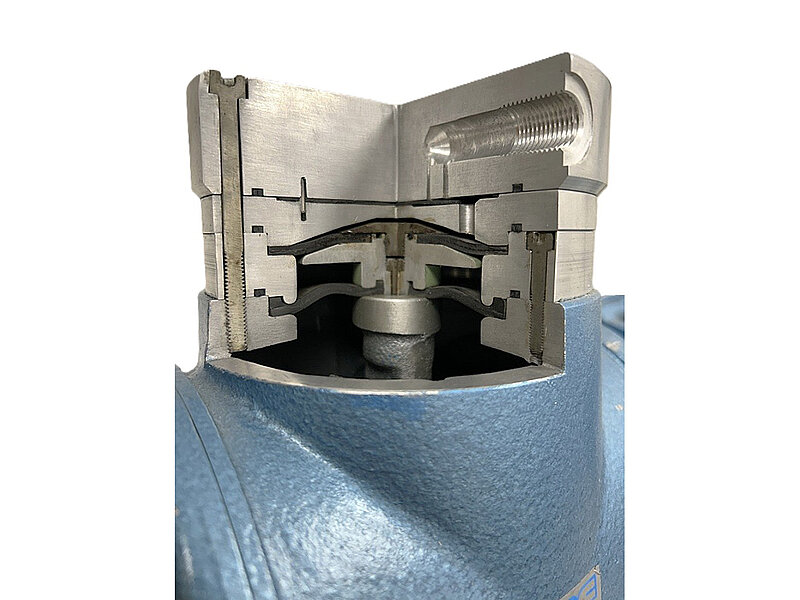
In safety diaphragm pumps, the safety diaphragm is mounted below the working diaphragm which creates a safety chamber between the two membranes.

The safety diaphragm serves as a backup in the pump and is only used should the working diaphragm crack or rupture. Although this scenario is very rare, additional safety in extreme conditions is a must. If the working diaphragm cracks, the pump will no longer function normally, but the safety diaphragm will still ensure that no media escapes from the pump and that no ambient air enters. Full operational capability of the safety diaphragm is guaranteed through the advanced pump design: Although both diaphragms are moved up and down by the drive, only the working membrane comes in contact with the media. As long as the working diaphragm is intact, the safety diaphragm is not exposed to the media. In addition, it is only subject to low thermal or mechanical loads maintaining its full ability to prevent leakage.

The Role of Safety Diaphragms in Diaphragm Gas Pumps
In safety diaphragm gas pumps, the safety chamber between the working and the safety diaphragm can be monitored by pressure changes or gas sensors. Should a crack in the working diaphragm occur and gas leak into the chamber, an alarm is triggered, and the safety diaphragm takes over to prevent leakage. The pump’s performance will drastically decrease until the working diaphragm is replaced. For challenging applications such as emission monitoring, gas analysis or processes in the chemical industry, KNF offers safety diaphragm pumps such as the N 630.12 to ensure the highest leak tightness.

How an Additional Diaphragm Ensures Safety in Liquid Pumps
Safety diaphragm liquid pumps monitor the working diaphragm. If a crack is detected, the safety diaphragm comes into action and ensures that the liquid is contained in the safety chamber and safely channeled out of the pump through a discharge outlet. The pump does not stop immediately and continues to operate without contaminating the other pump parts or the environment. However, it will alert the user to stop the pump for maintenance and inspection which is crucial to prevent harm. With its SIMDOS® series KNF offers various safety diaphragm liquid dosing pumps. The different material options for the working and safety diaphragm ensure its chemical resistance which makes pumps such as the SIMDOS® 10 FEM 1.10 S ideal solutions for the transfer of hazardous media in lab applications.
Customization is Key for Safety
Demanding applications pose strict safety requirements on the used systems. Adding a safety diaphragm is only one part, albeit a very important one, of meeting these standards. With KNF’s modular system, all pump parts can be customized and tailored to the specific application requirements, reinforcing the safety of the diaphragm pump to the maximum.