
Pump Head Configuration: How It Affects Flow and Vacuum Performance
Diaphragm pump performance depends heavily on pump head configuration. Learn how different setups influence flow, vacuum, and overall performance, and how to select the right configuration for your application.
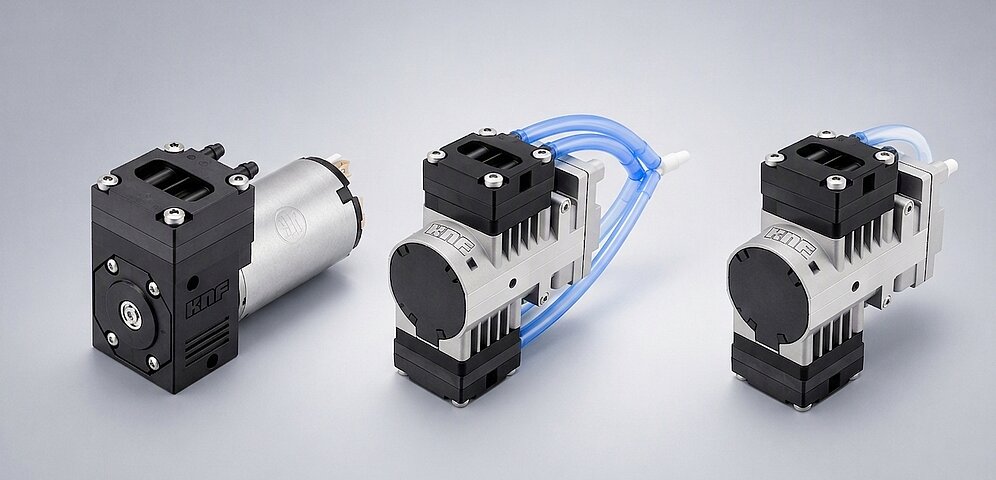
The required flow and vacuum levels determine the optimal pump head configuration. Choosing the right solution is crucial, as it directly impacts application performance. Engineers can select single-, dual- or multi-head designs, which can be connected in parallel, in series, or in combination.
How Diaphragm Pumps Generate Vacuum
Vacuum is created by continuously removing gas molecules from a system connected to the pump inlet. As gas is removed, the system pressure drops below atmospheric pressure, generating vacuum. This principle is widely used in industrial applications such as pick-and-place robotics, drying, degassing, gas sampling and analysis, leak testing, and Drop-on-Demand inkjet pressure control.
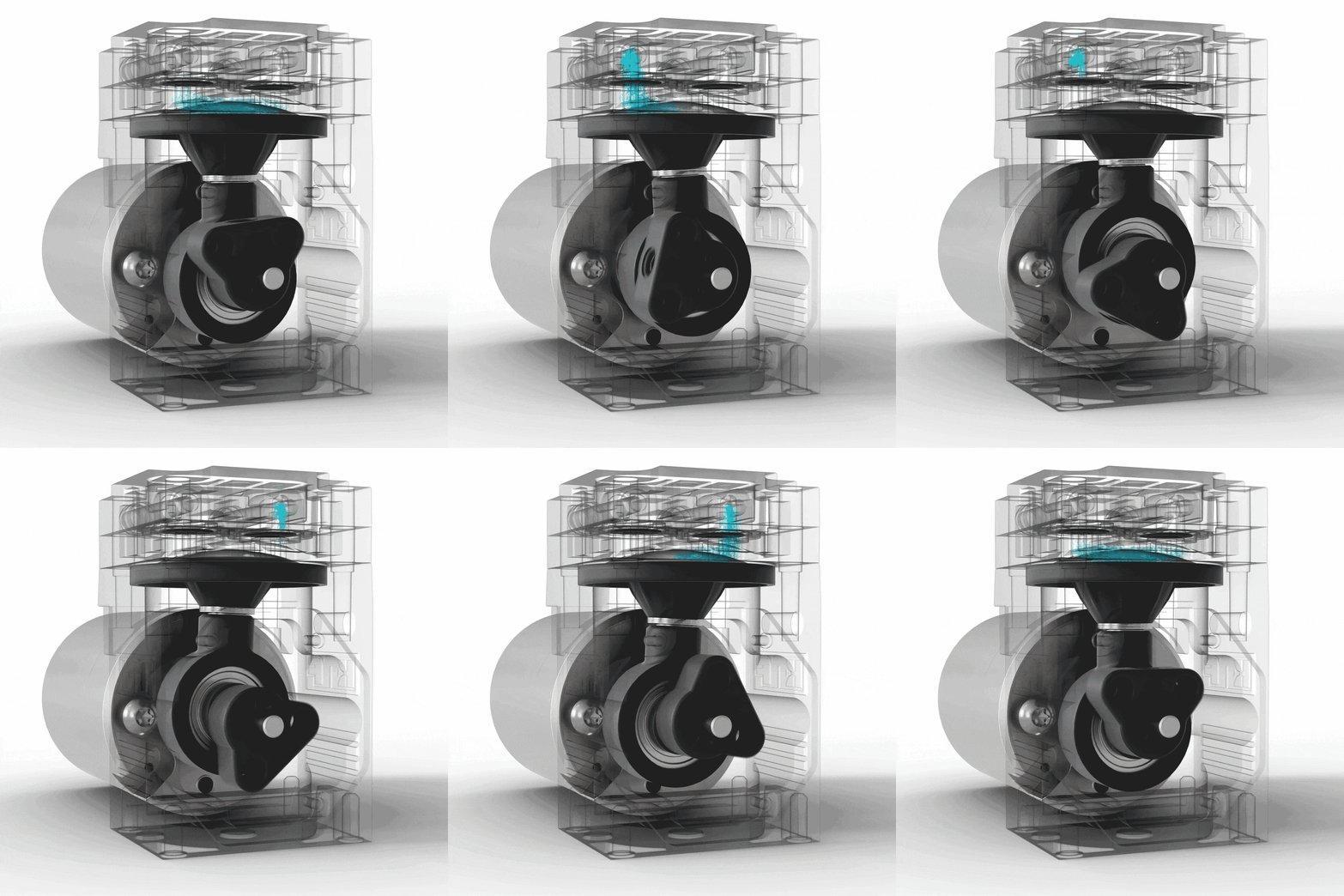
Diaphragm pumps are ideal for vacuum generation because they offer excellent leak-tight, oil-free, and reliable operation. They generate flow, and therefore vacuum, through the reciprocating motion of a flexible diaphragm. While the diaphragm mechanism defines how gas is drawn in and expelled, the pump head configuration determines how much gas is moved per cycle, how effectively the pressure is reduced in stages, and how performance is maintained across the operating range.
How Diaphragm Pump Head Configuration Impacts Performance
The performance of a diaphragm pump is illustrated by its
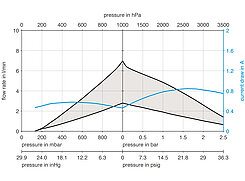
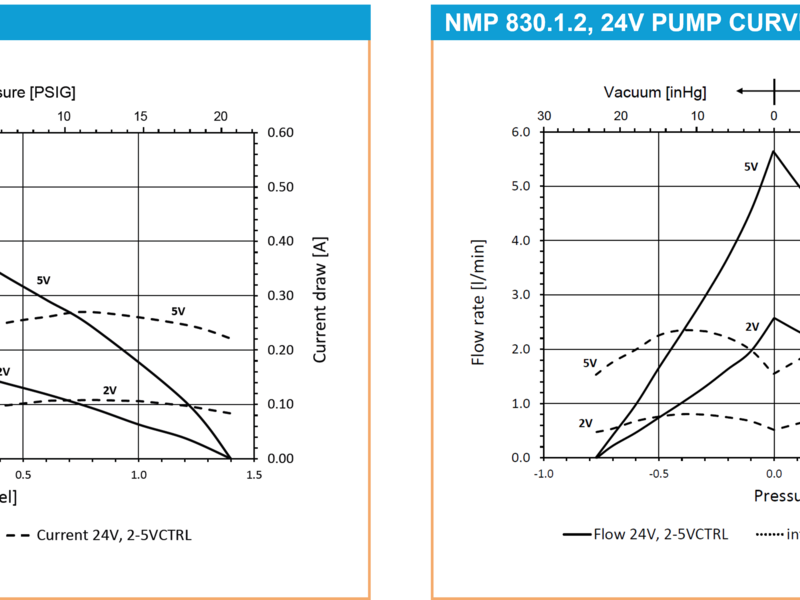
pump curve, which shows the relationship between flow and pressure across the operating range. As vacuum increases, flow decreases, so both values must be considered together when selecting a pump.
Pump head configuration directly shapes this relationship by influencing gas displacement, pressure differentials, and valve behavior. This allows configurations to be optimized for high flow, deep vacuum, or a balanced combination of both. Understanding how diaphragm pump heads interact is therefore essential for selecting a solution that delivers efficient and stable performance.
Single-Head Diaphragm Pumps for Compact and Reliable Vacuum Generation
Single-head diaphragm pumps represent the most fundamental pump head configuration and serve as the performance baseline for all others. Built around one pumping chamber and one reciprocating diaphragm, they provide a reference point for understanding the benefits of adding additional heads or stages. With one flow path, single-head pumps such as KNF’s N 96 deliver stable flow and moderate vacuum levels in a compact size. With a maximum flow rate of 8.5 l/min, a maximum pressure of 2.5 bar (rel.), and a maximum ultimate vacuum of 100 mbar (abs.) it is suitable for applications like stationary emission measurement, portable gas measurement, diagnostic systems, and instrumental analysis.
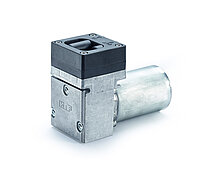
Although single-head pumps provide many benefits, they have natural limits in both flow rate and achievable vacuum. Higher flow could theoretically be obtained by increasing the operating frequency, but this can lead to excessive heat generation, diaphragm fatigue, reduced valve responsiveness, and increased noise and vibration. With one vacuum stage, a single-head pump also reaches its ultimate vacuum sooner than double- or multi-head configurations. As vacuum increases, fewer gas molecules remain, and the small amount of internal leakage through valves and sealings becomes increasingly significant. Eventually, leakage will equal the gas removed per stroke, and the pump can no longer lower the pressure. Multi-head configurations offer clear advantages when applications demand higher flow, deeper vacuum, increased pressure capability, or more stable performance across the operating range.
Increasing Flow with Parallel Pump Head Configurations
Parallel pump head configurations are used to optimize flow and typically consist of two or more pump heads. Each head operates independently, but all are driven by the same motor. Their displacement volumes add up, increasing the flow rate while the ultimate vacuum remains unchanged. To support different application requirements, KNF offers several connection options for double-head diaphragm pumps operated in parallel:
- Parallel inlet (1): Both pump heads draw gas from one inlet and create a high flow rate on the suction side.
- Parallel outlet (2): Both heads discharge through one outlet which generates a higher flow rate on the pressure side.
- Parallel in/out (3): Both pump heads use a shared inlet and outlet generating a high flow rate on both the suction and pressure side.
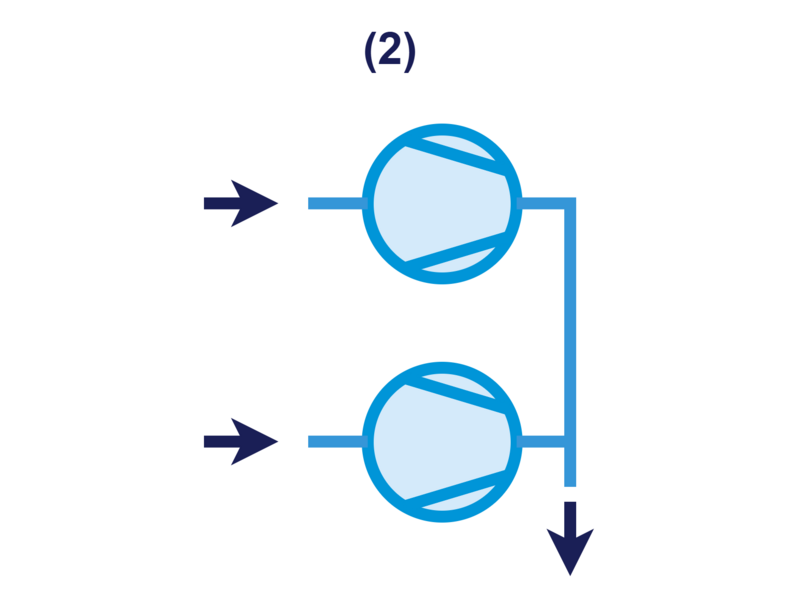
For applications requiring maximum throughput, KNF also offers multi-head solutions such as the NMP 850.7 micro diaphragm gas pump. With four pump heads operating in parallel it delivers a maximum flow rate of 25.5. l/min and maximum ultimate vacuum of 180 mbar (abs.). Typical applications include reprographics, environmental monitoring, medical devices, and food applications.
Diaphragm liquid pumps can also be customized using multi-head configurations. Because liquids are incompressible, these configurations have a limited impact and are typically used in parallel. This increases flow and reduces pulsation, which is beneficial for dosing, transfer, or applications requiring a smooth and stable liquid flow. KNF offers multi-head liquid pumps on a project basis.
Optimizing Vacuum with Serial Pump Head Configurations
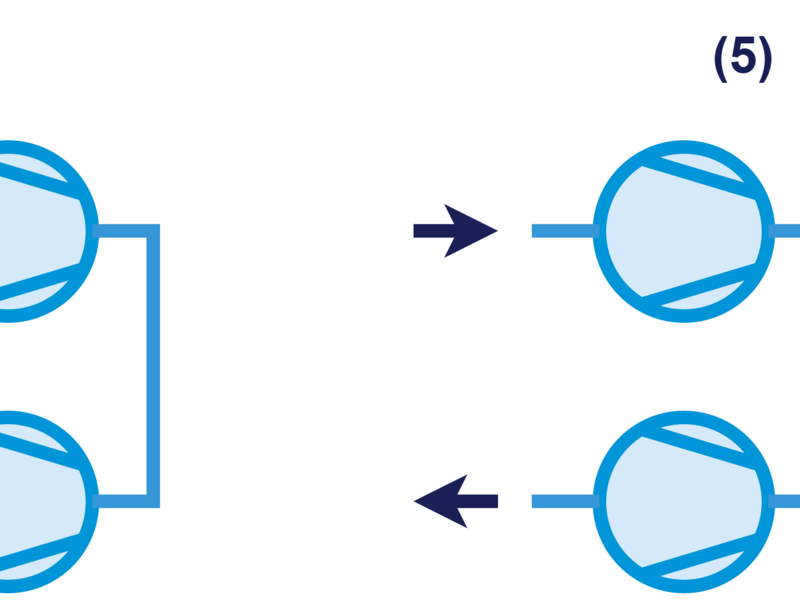
Serial pump head configurations are required to achieve deeper vacuum. In this setup, all pump heads are driven by the same motor and operate with the same stroke frequency as gas passes through them one after the other. Each stage reduces pressure further, overcoming the limitations of a single-head configuration. Serial configurations commonly use two, three, or even four heads and maintain better throughput at low absolute pressures. Widely used serial configurations for multi-stage vacuum performance include:
- Two pump heads connected in series (4) generate the flow of one pump head and a two-stage vacuum.
- Four pump heads connected in series (5) for a flow rate of one pump head and a four-stage vacuum. This configuration increases the overall size of the pump.
Enhancing Flow and Vacuum by Combining Parallel and Serial Configurations
In addition to purely parallel or serial arrangements, KNF offers multi-stage diaphragm pump configurations that combine both principles. These hybrid versions use several pump heads arranged in parallel and in series to deliver higher flow, deeper vacuum, or a combination of both within one pump. Depending on the design, multi-head configurations can also help reduce pulsation, contributing to smoother system operation in sensitive applications.
Hybrid pump head configurations are typically used when applications require fast evacuation, strong performance at low absolute pressures, or stable flow under varying loads. KNF’s N 84.5 vacuum pump, for example, uses two heads connected in parallel and two in series, resulting in exceptionally high suction speed.
Tailored Pump Head Configurations for Specific Requirements
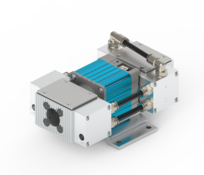
Beyond standard connections, KNF provides special pump head configurations for unique performance needs. These include independent pump heads for handling two separate gas paths, bidirectional parallel-serial routing that switches flow paths automatically at defined pressures, and two-stage compressor setups that increase pressure while maintaining the flow of a single head. KNF also supports applications with dynamic pressure or vacuum demands through intelligent pump features. The MGP 75 uses a dual-head design with integrated sensors and closed-loop Pressure Control to automatically adjust performance and maintain stable vacuum or pressure, even under changing conditions.
How to Choose the Right Diaphragm Pump Head Configuration
Selecting the ideal diaphragm pump head configuration depends on the specific performance requirements of the application. Relevant factors include required flow rate, achievable vacuum level, desired pressure, available installation space, gas load, duty cycle, and system dynamics such as leaks or restrictions. The optimal configuration depends on how these parameters interact within the system.
As a general guideline:
- Choose a single-head pump for compact, standard-duty applications
- Choose a parallel configuration when higher flow is required
- Choose a serial configuration when deeper vacuum is needed
- Choose a hybrid configuration when both flow and vacuum performance are important
KNF engineers work closely with customers to analyze application requirements and recommend a suitable pump solution based on KNF’s modular system. In addition to pump head configuration, customization options also include various material combinations as well as mechanical and connection options. This gives customers the flexibility to tailor performance, footprint, and functionality to their specific needs.