Transferring Liquids: Direct-Liquid vs. Pressure-Over-Liquid Transfer
When liquids need to be transferred, there are different possible approaches: direct-liquid transfer and ...
Read more


When selecting a pump for a gas application, there are a variety of technologies to choose from. Among those technologies are diaphragm pumps and swing piston compressors. Both of these pump types have proven success in a variety of gas applications. Diaphragm pumps and swing piston compressors both have strengths that make them especially effective in very specific applications.
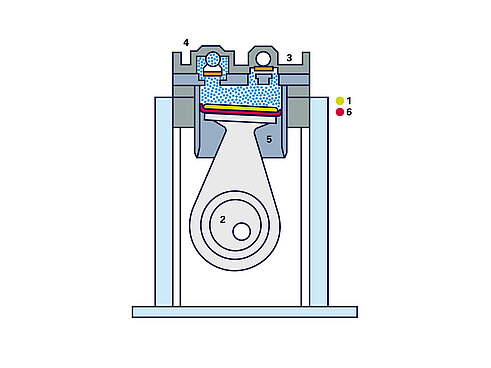
Piston compressors, sometimes called swing piston pumps, are frequently found in gas applications. These pumps are typically powered by an electric motor that drives a connecting rod with an eccentric attached to a piston. As the piston moves upwards and downwards within the cylinder, the gas in the working chamber is compressed or expanded. By doing so, the piston will tilt from side to side, giving its name swing piston.
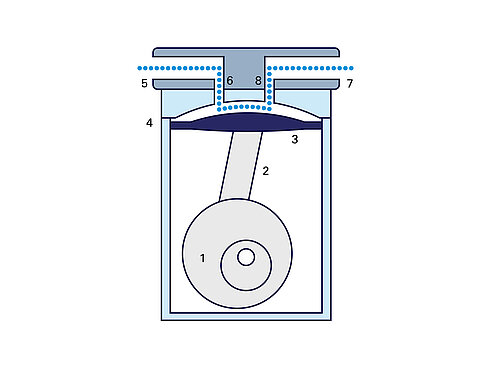
Diaphragm pumps typically use a motor connected to an eccentric. The eccentric translates the rotating motion of the motor into an up and down movement. This movement is then transferred to a flexible diaphragm via a connecting rod. The diaphragm draws media through an inlet valve on the downstroke and discharges it through an outlet valve on the upstroke. The diaphragm also acts as a seal, sealing the pump head tightly from the pump drive and the environment. Thus, the diaphragm has two functions at once: displacement and sealing. Diaphragm pumps are available in a variety of different pump head, valve, and diaphragm materials.
Both diaphragm pumps and piston compressors are commonly used in gas applications, and both pump types have several strengths. Both pump types are capable of generating strong flow. Because both technologies are suitable for use with different motors including advanced BLDC motors, diaphragm pumps and piston compressors are both capable of running at variable speeds, allowing for adjustable flow.
In addition to strong flow, both diaphragm pumps and piston compressors are very simple to maintain. They offer long service life and have parts that are relatively quick and easy to replace. Diaphragm pumps are especially resilient, as most of their parts have very long lifetimes. The sealing rings in piston compressors do tend to wear out due to the friction and stress, leading them to require more frequent maintenance than diaphragm pumps. However, they still have relatively long lifetimes.
While both pump types offer good flow rates, they offer very different properties when it comes to pressure. Swing piston compressors offer high pressure, making them strong choices for applications where that is required. The rigid piston and tight sealing allow the pump to generate higher pressure than diaphragm pumps. Pressure and flow rate can be further increased by designing the pump to have a longer piston stroke. This allows piston compressors to manage higher volumes of gas than diaphragm pumps. Even smaller swing piston compressors are capable of generating relatively strong pressure, allowing them to fit into a variety of systems.
A pump like KNF’s NPK 09, for example, offers maximum pressure of 7 bar (rel.) along with a maximum flow rate of 15 l/min. It is also compactly designed, allowing it to be easily integrated into new or existing systems. This combination of pressure generation and compactness is something diaphragm pumps cannot match.
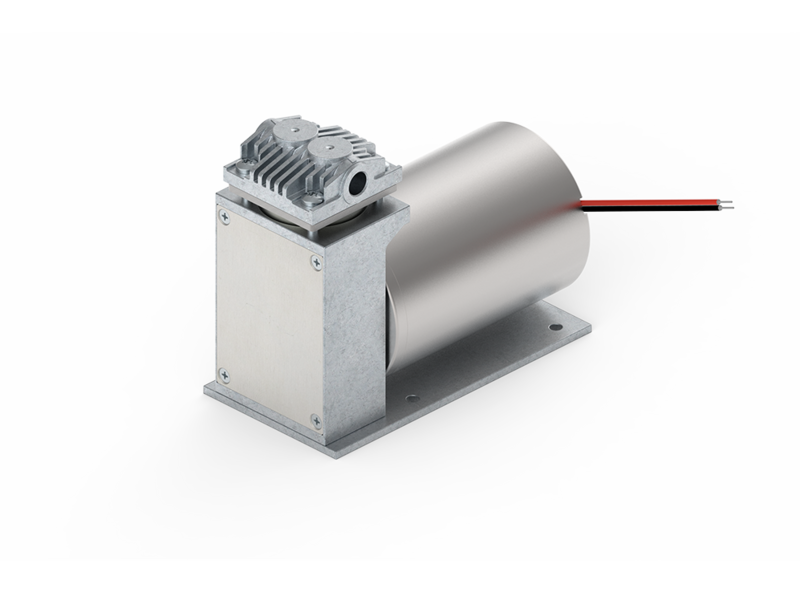
While they may not be able to generate as much pressure as piston compressors, diaphragm pumps also have many advantages. Diaphragm pumps can achieve much deeper vacuum than swing piston compressors. For example, KNF diaphragm pumps can achieve vacuum as low as 0.5 mbar (abs.), while swing piston compressors can only achieve about 30-50 mbar (abs.) for larger swing piston compressors and 100 mbar (abs.) for smaller ones.
Diaphragm pumps inherently offer excellent leak tightness due to their construction. The diaphragm acts as a seal, preventing gases from leaking out of the pump head and contaminates from entering it. This is essential in applications involving rare, expensive, pure, or dangerous gases. Diaphragm pumps can also be designed for additional protection against leakage through additional O-rings and more rigid head materials. The addition of a safety diaphragm further protects against leakage if the working diaphragm fails. While piston compressors do have seals, they are susceptible to wear and need to be replaced frequently. Because the piston is moving within the cylinder, piston compressors also lack the inherent leak tightness of diaphragm pumps.
Diaphragm pumps also offer very strong material compatibility and chemical resistance. Diaphragms, as well as other pump parts like valves, and pump heads, can be built from a variety of materials depending on the gas that needs to be transported. This makes diaphragm pumps a strong choice for applications where dangerous or aggressive gases will be a factor. Piston compressors have much more limited material options, making them unsuitable for some applications involving challenging media, particularly those involving wet gases.
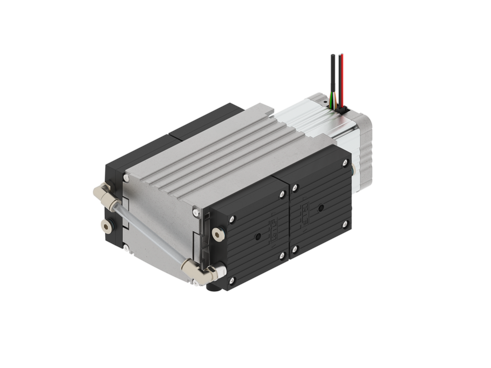
For example, KNF’s N 952 is available in a variety of versions, with options like PTFE coated or EPDM diaphragms. This allows the pump to be custom tailored, ensuring the diaphragm is capable of handling the gas being transferred. While piston compressors can have different seal materials, material options for the piston itself are limited. The N 952 also offers strong performance, with a maximum flow rate of 36 l/min, maximum pressure of 0.1 bar (rel.) and maximum vacuum of 1.5 mbar (abs.).
While both pump types have their strengths, which one to choose largely depends on application. Swing piston compressors are the optimal choice where strong pressure and consistent flow are required. Medical applications like shockwave therapy and needle drying, inkjet printing applications involving gas over liquid transfer, food and beverage, and pick and place applications are just a few instances where high pressure pumps are required.
By contrast, diaphragm pumps are a stronger option for any application that requires leak tight operations. This includes medical diagnostic and emission measurement applications, where it is critical that no gases leak out of or into the system to ensure sample quality. Leak tightness is also essential in applications involving the transfer of dangerous or valuable media. Diaphragm pumps are also a better option, and in many cases a required one, in applications involving aggressive or wet media due to their superior chemical resistance and compatibility. The wide variety of diaphragm, valve, and pump head options allow these pumps to be specially customized for specific applications.
Regardless of which option you choose, working with an experienced pump partner is essential. KNF offers a wide range of both diaphragm and piston compressor pumps that can be tailored to meet the needs of most systems.