Tamper-Proof Exhaust Emission Tests
For valid soot particle measurements: Portable calibrating system for measuring instruments in accordance...
Read more

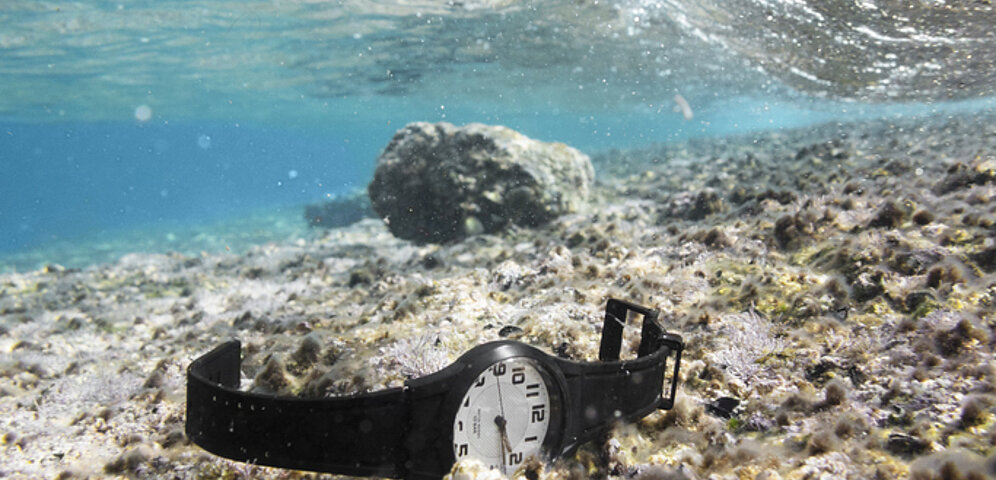
Waterproof up to 5 bar, 5 atm or 50 meters – almost all watches have an inscription of this kind.
But what does that actually mean? Was the watch actually submerged in water to check if it’s water tight?
Obviously not. The watch is tested non-destructively, using air. The integrated valve module combines the valve technology competence of Christian Bürkert GmbH & Co. KG with the compressor know-how of KNF.
The leaflet states whether a watch is watertight and how much pressure it can resist. But how long it will actually stay watertight is difficult to predict. The reference point for its waterproofness, which is determined according to test standards, is therefore always its new condition.
Regular watches are tested for waterproofness according to the ISO 2281 standard, while diver’s watches are tested following the ISO 6425 standard. The watch is subjected to a pre-determined pressure for a certain amount of time. If the watch withstands the pressure, it is tight – at least at the point of testing.
3, 5, 10 or 20 – the number on the watch case back tells the watchmaker how much overpressure must be applied to meet the test standards.
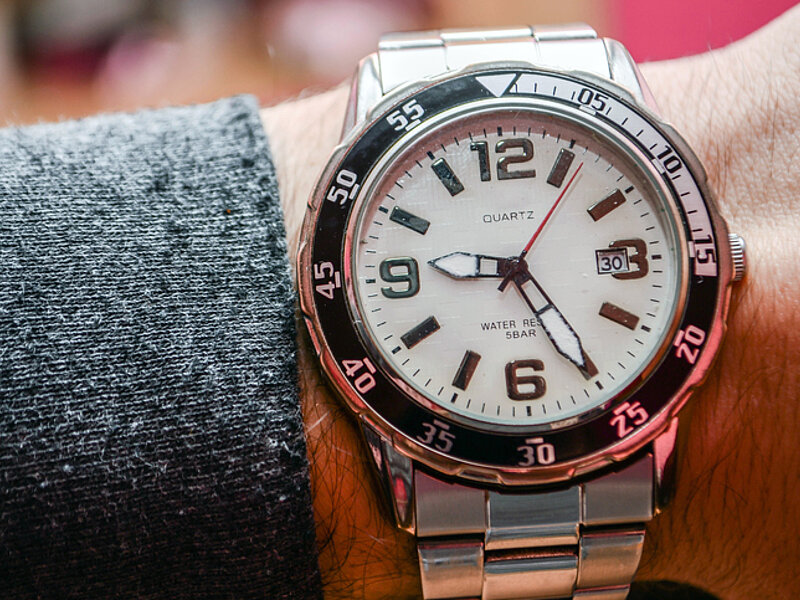
The information provided in bar, atm or meters is nothing more than a snapshot and therefore only intended as an indication. The specification of 3 bar, 3 atm or 30 meters means that the watch is resistant to sweat or splash water. Only watches with the specification of 5 bar, 5 atm or 50 meters remain watertight during bathing or swimming.
Nevertheless, a watch’s waterproofness should be tested about once per year, as the sealing elements age and become brittle. The water-pressure test with compressed air is therefore a standard step during service and repairs or when the battery is replaced.
The water-pressure test involves measuring the deformation of the watch case. Its re-expansion depends on the free volume of the watch. If there is a leak, it means the correlation between re-expansion and deformation is disturbed and the measuring process is interrupted.
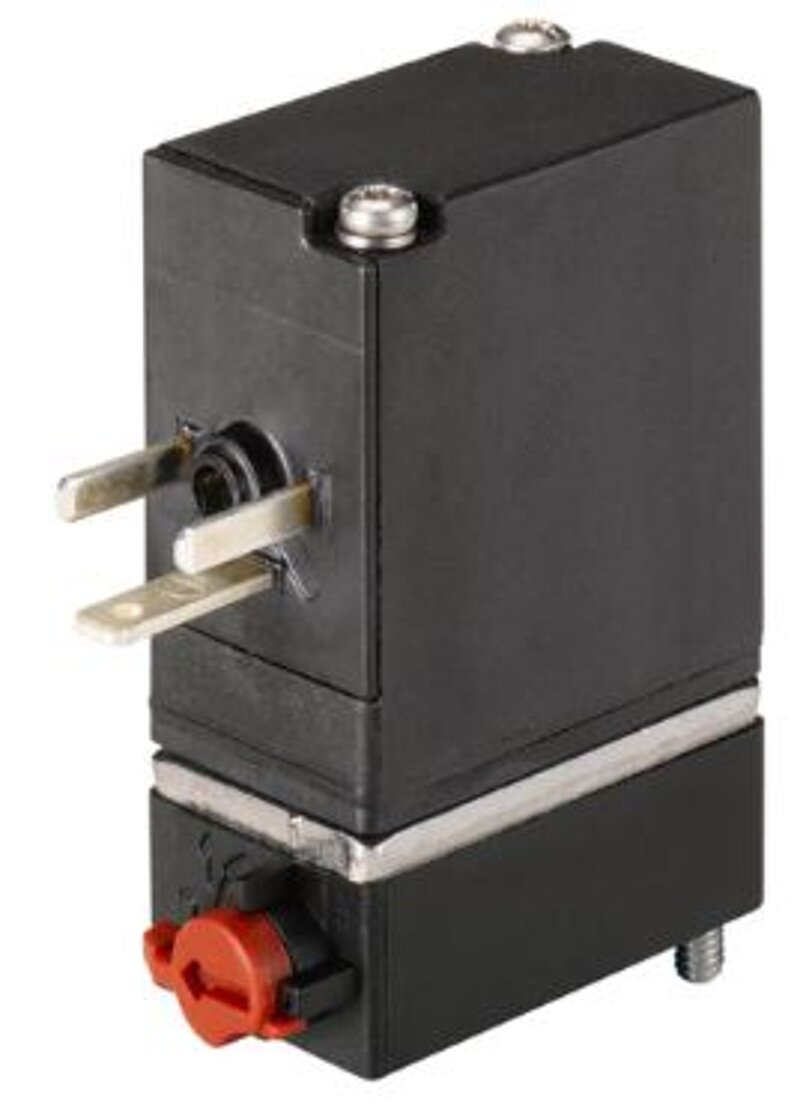
The leak test in the testing device is controlled by a pneumatic module. This module, which consists of a customer-specific plastic injection molded part, 2/2-way valves, and a compressor, is manufactured by Bürkert.
The individual valves control the process and switch the pump to no load, among other things. The compressor starts up without any problems, and when the maximum pressure is reached, the valve shuts off the test chamber and simultaneously relieves the compressor.
In the testing device, the pressure reached is regulated to defined pressure levels – for example, 5 – 3 – 1 bar. These levels correspond to the various leak testing requirements. The measured values are logged at the respective pressure levels.
The pressure vessel is made of aluminum. The light metal, which is a good heat conductor, quickly dissipates the heat generated by compression.

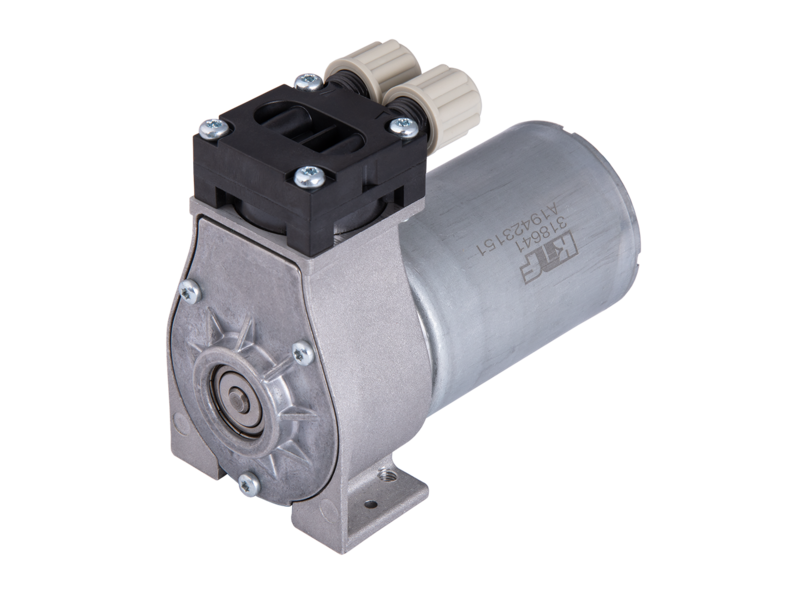
Compressed air is required to perform leak tests in watch workshops or stores. Bürkert relies on the powerful KNF compressor from the NPK 06 series for this application.
The pump is flanged directly to the Bürkert valve unit via a manifold. This eliminates the need for hose connections and interfaces that could cause leaks during measurement. The connection via the manifold is a modification of the standard pump model for this application.
The pump meets additional requirements for this application. The test pressure of 5 bar must be reached within a specified short time, which is no problem for the NPK 06. It is small and compact, yet a real powerhouse. Its special advantage is the brushless, durable motor with ideal torque for this task.
In addition, the dead volume in the pumping chamber of the NPK 06 has been increased and a reduced eccentric has been installed. This modification prevents the motor from overheating and load shutdown.