
Transferring Liquids: Direct-Liquid vs. Pressure-Over-Liquid Transfer
When liquids need to be transferred, there are different possible approaches: direct-liquid transfer and pressure-over-liquid transfer. But what are the differences and possible limitations?
When faced with the task of moving liquids, engineers can choose to pump media directly through a liquid pump. A lesser-known approach is to use a pressure difference created via an air pump which indirectly transfers the liquid. It is important to know the differences, benefits, and limitations of both transfer methods to find the perfect fit for your application. If aspiration is required, the vacuum-over-liquid approach could be an option.
How Does Direct-Liquid Transfer Work?
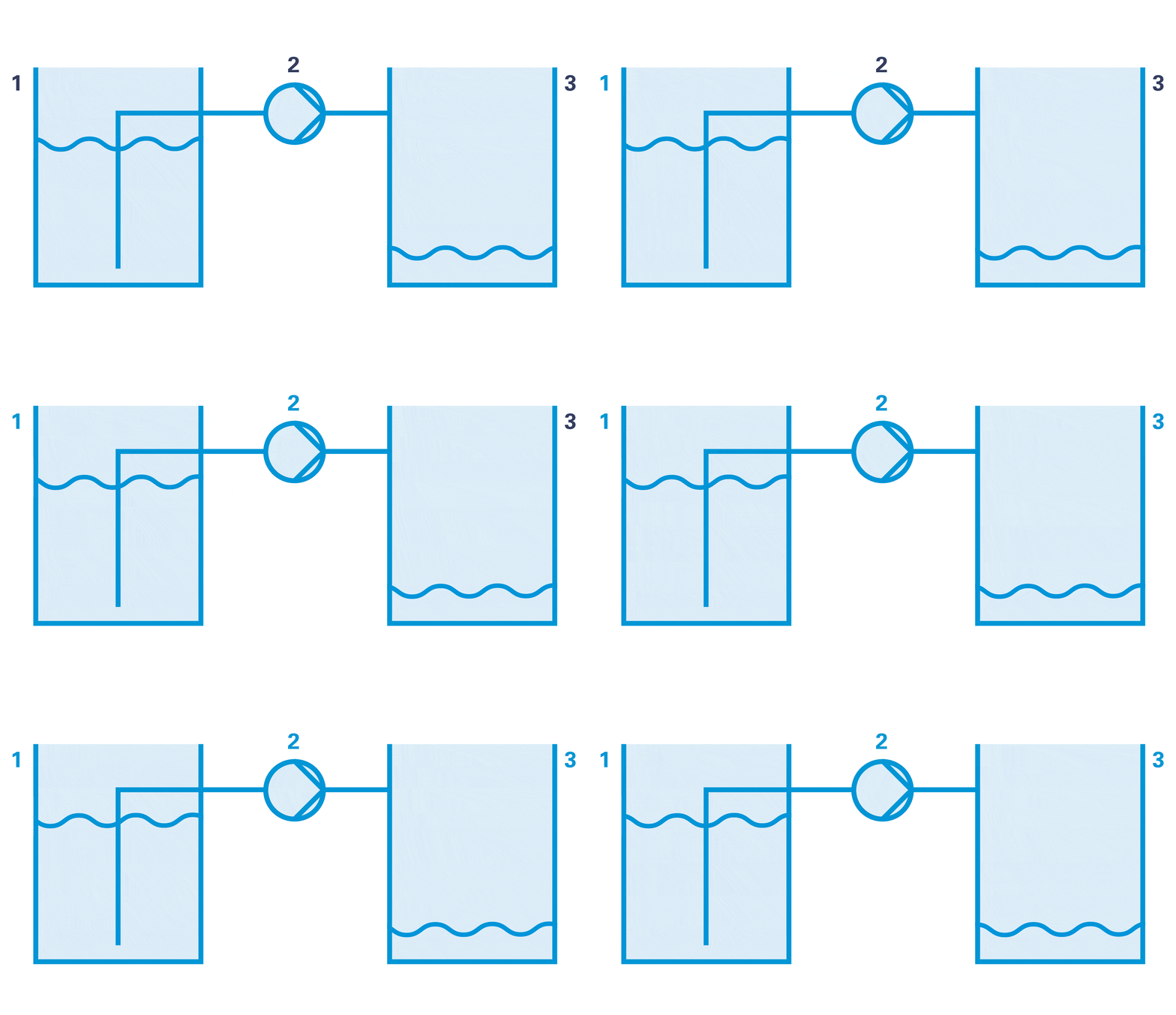
Using the direct-liquid transfer approach, a pump sucks in the liquid on the inlet side from a source container and discharges it on the outlet side into a receiving container. Through steady operation, this pumping method can create accurate and consistent flow rates.
Benefits of Using Direct-Liquid Transfer Systems
Direct-liquid transfer systems offer numerous advantages, largely influenced by the pump technology employed. Common benefits include:
- Rapid and effective liquid movement
- Steady and uninterrupted flow
- Simple system architecture
- Precise and fast control over flow rates
Some pump technologies also require minimal upkeep. Depending on the application, additional pump benefits include:
- Resistance to aggressive chemicals
- Ability to self-prime
- Safe operation even when dry
- Dependable performance and extended service life
Understanding the specific needs of the application is key to selecting the right pump for this transfer method. Systems that use the direct-liquid approach are particularly well-suited for transferring, metering and sampling tasks of various liquids. Use cases include the ink transfer within printing machines, medical diagnostic applications or the handling of cleaning agents, e.g. in textile cleaning.
Challenges of Direct-Liquid Transfer
While direct-liquid transfer is widely used for moving liquids, it does have certain drawbacks. Since the liquid passes directly through the pump, contact with pump components is unavoidable. This can be problematic when handling:
- liquids with fibrous content, which may clog the pump
- abrasive substances that can wear down internal parts
In applications demanding high hygiene standards or frequent cleaning, this method may fall short. Pumps used in these systems often cannot be thoroughly and easily sterilized or disinfected without leaving residues. Additionally, complex setups requiring multiple media streams can become cumbersome and expensive, as each stream needs its own dedicated pump. Also, pressure pulsation can be an issue for certain applications.
Why Diaphragm Liquid Pumps Excel in Direct-Liquid Transfer
Diaphragm pumps are particularly well suited for direct-liquid transfer applications. They deliver consistent and accurate flow and can handle pressures up to 16 bar (rel.). Their self-priming capability allows them to start pumping without pre-filling, and they are designed to operate safely when dry. These pumps can be tailored to meet specific chemical and operational requirements, making them highly adaptable and reliable. The diaphragm acts as a dynamic seal, preventing leaks and reducing contamination risks, which is especially important when transferring sensitive or corrosive liquids.

For systems that require low pulsation, KNF’s Smooth Flow technology offers an effective solution. By integrating dampers or using multiple phase-shifted diaphragms, this innovation significantly reduces pressure peaks. One example is the FP 1.7 Smooth Flow pump, which features an integrated dampening diaphragm to minimize pulsation, vibration, and noise, and ensure stable performance in direct-liquid transfer systems.
Pressure-Over-Liquid Transfer Explained
In a pressure-over-liquid transfer system, ambient air is pumped into a source container via a gas pump, creating pressure. The pressurized air is then used to push the liquid through the system, which is connected via lines and valves to receiving containers.
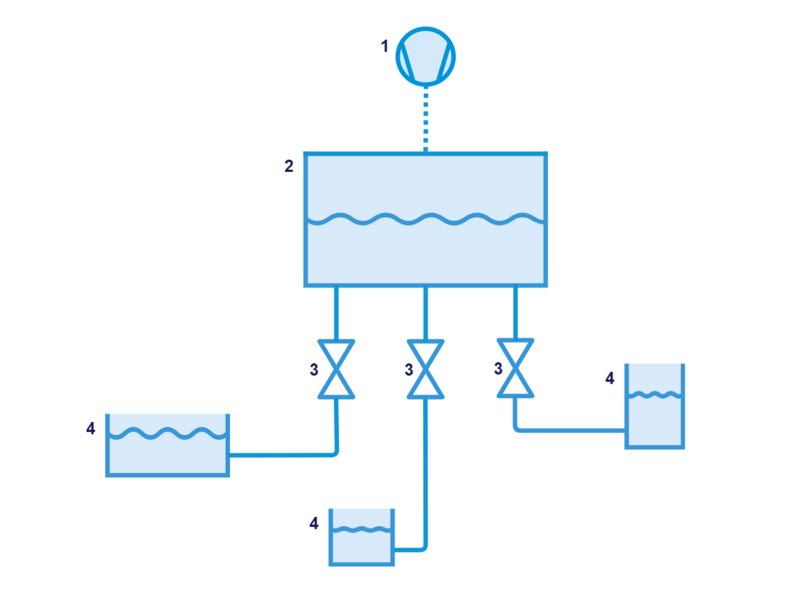
Various pump types are available for pressure-over-liquid transfer. This includes diaphragm pumps, which are an ideal solution, and swing piston pumps for higher pressures. When used as pumps for pressure-over-liquid applications, diaphragm pumps offer several benefits over other pump types:
- Oil-free operation
- Customized fit
- Available with a wide range of certifications, including explosion-proof and food-grade compliance
- High reliability
- Clean operation without internal abrasion
Advantages of Pressure-over-Liquid Transfer
Using the pressure-over-liquid transfer approach, many pump lines can be used with just one pump. This can help to simplify complex liquid systems. In systems using the pressure-over-liquid method, the transferred liquid does not run directly through the pump, which offers several advantages. It enables the transfer of viscous or abrasive liquids or media that contain particles and fibers because they cannot clog up the pump. It also ensures that the pump remains clean so the system can be cleaned easily and prevents cross-contamination. By using an air-pressurized container, the pump only needs to run when the gas pressure gets low, which can reduce energy consumption and noise. In addition, the pressure-over-liquid transfer provides a very smooth flow with almost no pulsation.
Limitations of Pressure-Over-Liquid Transfer
In pressure-over-liquid transfer systems, the pump’s operation is not directly linked to the liquid being moved. The pressure applied to transfer the liquid can vary. This can result in less consistent flow rates and less precise flow compared to direct-liquid transfer. One diaphragm pump or swing piston pump can supply multiple lines. To regulate the flow and control the pressure, valves and valve control need to be implemented, thus potentially increasing system complexity and maintenance time and costs. As it might take the pump some time to regulate a certain target pressure, pressure control in sub-tanks can be slow. Another downside of pressure-over-liquid system can be lower efficiency since the system needs to first compress air to then move the liquid. Depending on the system design, potential friction losses can further reduce system efficiency.

Gas Pumps for an Efficient Pressure-Over-Liquid Transfer
Gas pumps used for pressure-over-liquid applications need to efficiently and reliably compress air. In addition, oil-free and low- to no-maintenance operations are essential. Some systems also greatly benefit from highly compact pump solutions. These requirements make diaphragm pump technology the ideal choice. Depending on the flow and pressure required, a double-headed diaphragm pump can be used. The micro gas pump NMP 830.1.2 HP is a strong choice for a pressure-over-liquid transfer solution that is highly efficient, compact, and reliable.
For reliable flow and pressure control, KNF offers a wide range of motor options, including parametrizable BLDC motors. This allows the setting of maximum and minimum speed ranges as well as fixed values to provide strong and consistent flow rates. In addition, micro gas pumps offer low pulsation and noise. As an alternative to diaphragm pumps, swing piston gas pumps can be a suitable choice for pressure-over-liquid applications. They offer an excellent pressure and flow rate in a compact footprint. Like all KNF pumps, they can be customized to meet the specific transfer process requirements.
How To Choose Between Direct-Liquid and Pressure-Over-Liquid Transfer?
Which approach is chosen depends on various factors, including the media transferred, the number of lines in the system, requirements for the cleanliness of the system, and many more. Diaphragm pumps are a perfect fit for both approaches because they combine all the advantages in one solution. KNF engineers can help customers find the right approach for their application. They can help customers choose the best fit and customize the pump solution to their specific needs.