
Suctioning Liquids: Direct-Liquid Transfer vs. Vacuum-Over-Liquid Transfer
Liquids can be drawn using the direct-liquid or the vacuum-over-liquid transfer method. It is important to know the differences when choosing the right approach and pump solution.
Drawing liquids seems like a simple task, but choosing the right aspiration method can be difficult. One option is direct-liquid transfer, where media is pumped directly through a liquid pump. When using vacuum-over-liquid transfer, a vacuum is used to suck in the liquid. Both approaches have their advantages, but also limitations. It is important to understand the differences to meet the specific requirements of the application. In cases where the focus is on liquid transfer instead of liquid aspiration, the lesser-known pressure-over-liquid transfer can be an alternative approach.
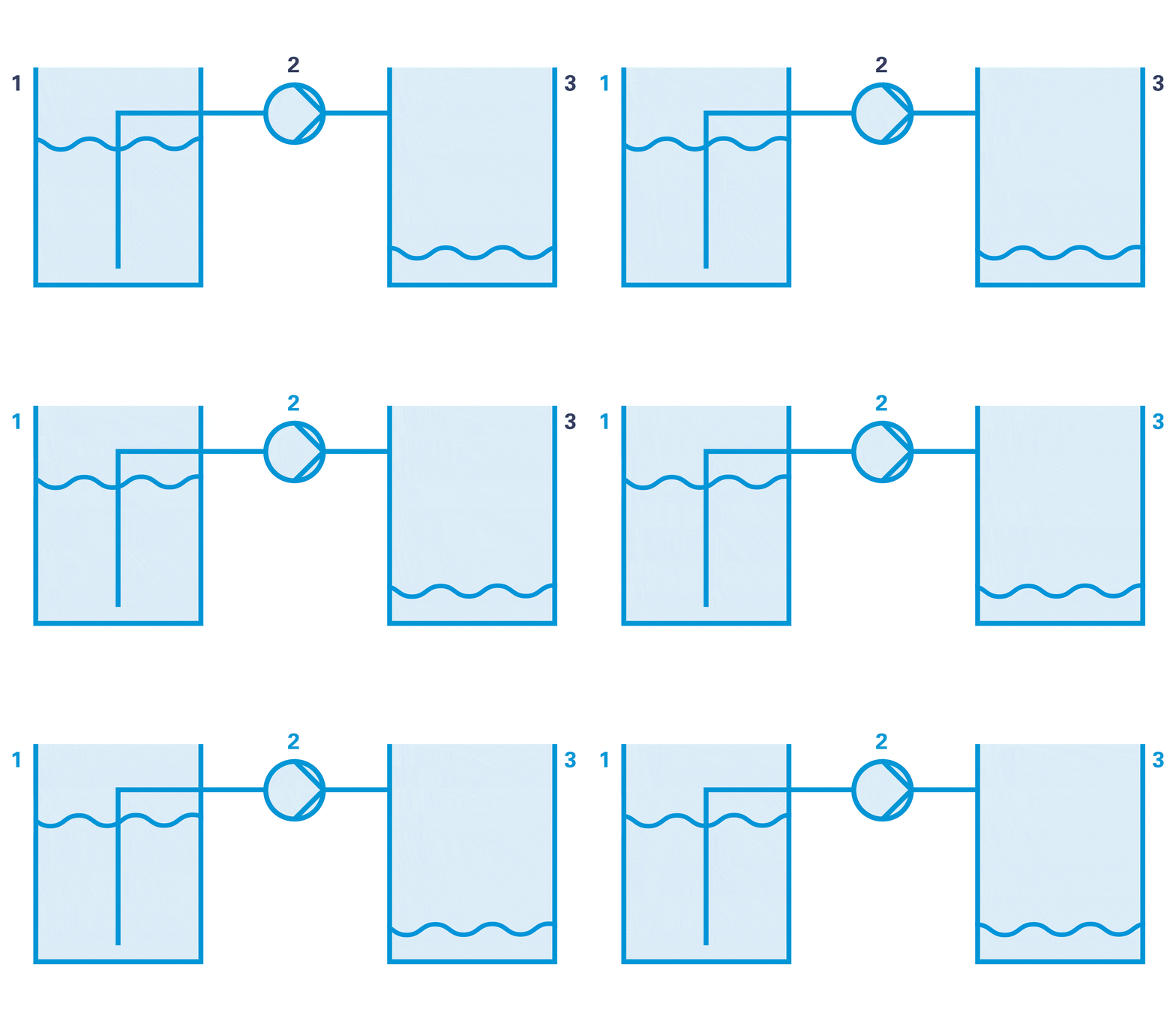
Direct-Liquid Transfer Explained
Using the direct-liquid transfer approach, a pump sucks in the liquid from a source container on the inlet side and discharges it on the outlet side into a receiving container. Through steady operation, this pumping method can create accurate and consistent flow rates.
Advantages of Direct-Liquid Transfer Systems
Pumps for direct-liquid transfer systems offer a wide range of advantages. However, those advantages are determined by the specific pump technology used. Regardless of the exact pump technology, direct-liquid systems usually offer the following benefits
Quick and efficient liquid transfer
Continuous liquid discharge
Low system complexity
Excellent flow rate control
Many systems designed with this approach also offer low maintenance requirements. The following advantages can be achieved by selecting the right pump technology
High chemical resistance
Self-priming
Safe to run dry
Long-term reliability and long lifespan
It is important to know the application-specific requirements to choose the right pump type for this transfer method. Direct-liquid transfer systems that combine all these advantages are ideal for aspiration applications. This includes waste removal in medical and diagnostic applications, inkjet printing systems, and laboratory applications.
Limitations of Direct-Liquid Transfer
Even though direct-liquid transfer is a very common way of drawing liquids, this method has its limitations. With this approach, the liquid always flows through and comes in contact with the pump, which can be problematic in some cases. Liquid containing long fibers could clog up the pump and highly abrasive particles can cause damage.
Applications requiring high cleanliness and frequent cleaning of the liquid system might also face problems, because most pumps cannot be cleaned, sterilized, or disinfected easily without leaving residues. The setup of highly complex systems with this approach might also be challenging as one pump is needed per media stream. This makes the design of systems that need to transfer liquids in many different separate lines difficult and potentially costly.
Diaphragm Pumps: The Best Choice for Direct-Liquid Aspiration
Diaphragm liquid pumps are ideal for quickly and efficiently suctioning liquids. They ensure precise and repeated delivery and can also be used in applications that require pressures of up to 16 bar (rel.). Thanks to their design, they are self-priming, allowing them to generate suction when dry and start pumping without priming. Another unique factor of those pumps is their ability to run dry safely without being damaged.
To ensure a perfect fit for the specific requirements of the liquid and application, KNF diaphragm pumps can be customized. This makes them not only highly versatile and chemically compatible in demanding applications but also guarantees a long service life with low maintenance needs. The diaphragm functions as a dynamic seal ensuring leak-proof operation and minimizing the risk of contamination when transferring corrosive, aggressive, or sensitive liquids.

Some systems require minimal pulsation. While diaphragm pumps are often ideal solutions, they, like all positive displacement pumps, generate pulsation. KNF has developed Smooth Flow technology allowing diaphragm pumps to be used in systems that are sensitive to pulsation. KNF’s Smooth Flow technology uses integrated dampers or several phase-shifted diaphragms to minimize pulsation. The FP 70 Smooth Flow pump is one such example.
Working Principle of Vacuum-Over-Liquid Transfer
In a system that uses the vacuum-over-liquid transfer approach, a vacuum pump evacuates air from a container. This container is connected to one or multiples lines via valves which allow liquid to be sucked in due to the pressure difference.
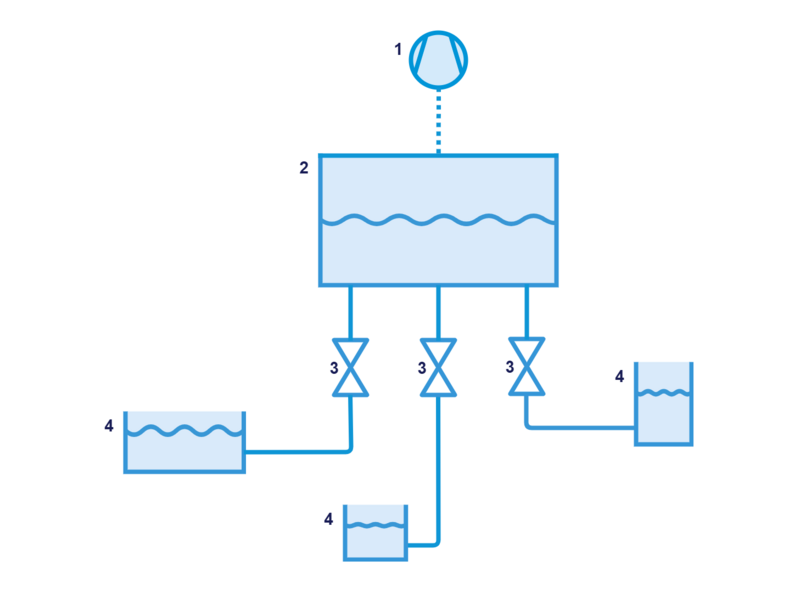
Advantages of Vacuum-Over-Liquid Transfer
The vacuum-over-liquid transfer approach offers advantages for many applications. Since the pump has no direct contact with the liquid, it is advantageous for particularly aggressive, hazardous, abrasive or sensitive fluids. This allows the media to maintain purity while preventing contamination and protecting the pump. It is a very versatile transfer method and can be used for a wide range of media, especially ones that have a high viscosity or contain particles or fibers. This transfer method also allows the setup of complex systems with just one pump powering multiple media streams.
Limitations of Vacuum-Over-Liquid Transfer
Vacuum-over-liquid transfer is used in many industries and applications, including waste removal and suction units in medical applications. Compared to direct-liquid transfer, the setup and operation of a vacuum-over-liquid system can be more complex. Since valves and a vacuum container are required, the system size is typically larger. Other limitations include increased sensitivity to temperature variations and occasional emptying of the container in which the liquid is collected. An overflow protection device needs to be installed in the receiving container to prevent damage to the pump or liquid leakage from the pump outlet into the customer’s system.
Vacuum-over-liquid systems also face challenges caused by the physical nature of liquids in the vacuum itself. The boiling point of liquids decreases as the vacuum becomes stronger. If the required transfer conditions – boiling point of the liquid, required vacuum level, and temperature – cause the liquid to boil, it cannot be transferred using vacuum. The vacuum effectiveness can also decrease with distance because of pressure losses in the system, which limits the maximum distance over which the liquid can be drawn.
Vacuum-Over-Liquid Transfer With Diaphragm Vacuum Pumps
The air evacuated in vacuum-over-liquid setups is in direct contact with the liquid and therefore normally contains moisture. This is important when it comes to transferring wet gases or aerosols, as condensate may form in the pump which can damage it. It is therefore important to design the pump specifically for handling condensate. To achieve this, KNF uses a highly modular system, which turns its diaphragm vacuum pumps into highly modular solutions designed to fulfill the specific needs of different customer applications. In addition, the pump should be installed as high up in the system as possible so that condensate can drain out.

Another key factor to ensure reliable operation in a vacuum-over-liquid system is to select a pump with the ability to start against vacuum. It must be able to start and deliver even if there is negative pressure on the suction side, which is particularly important if the system has already been evacuated.
Diaphragm gas pumps like the N 838.1.2 from KNF combine these benefits and offer a high-performance level combined with a compact size.
Which Transfer Method Fits Best – Direct-Liquid or Vacuum-Over-Liquid Transfer?
Several factors are critical for choosing the right liquid suctioning approach. These include flow and pressure requirements as well as operational conditions of the system and media specifications.
The vacuum-over-liquid method is the ideal choice when it comes to handling liquids that contain fibers or particles, or when the purity of the liquid and pump cleanliness must be maintained. This method is also useful when multiple media streams need to be transferred.
The direct-liquid transfer method ensures fast and efficient media transfer with excellent flow rate control. It is especially advantageous when only a few lines need to be powered and in cases where a continuous flow is key.
Choosing the ideal transfer method along with the right pump solution depends on the specific application requirements. The experts at KNF help customers choose the right approach and customize diaphragm pumps for each approach to their exact needs.