




Making the Right Material Choice for Liquid Pump Lines
Pump tubing in hydraulic systems can have a significant effect on the pump’s performance
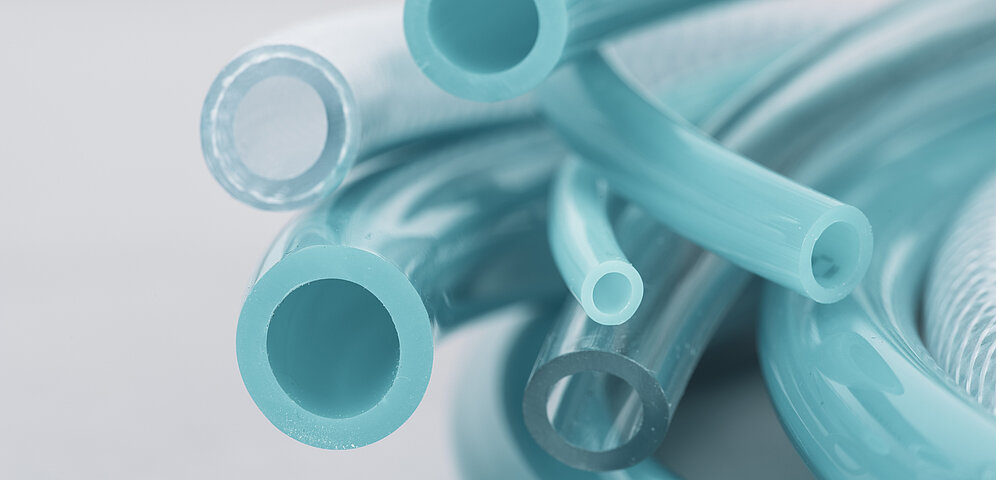
When connecting a liquid diaphragm pump hydraulically to a system, engineers face a multitude of material choices for the pump lines on both the suction and pressure sides. Choosing the right material is often more complex than it initially appears. Therefore, knowing the most important positive and negative effects pump tubing materials can have and knowing how to avoid or to leverage these effects is crucial.
Overwhelming Material Choices for Pump Lines
When designing a fluid system, many factors must be considered, including the required flow and pressure as well as the properties of the medium. One less prominent aspect is the choice of material for the pipes and tubes used in the system. Rigid pipes can be made of various metals and metal alloys, such as stainless steel or copper, as well as various polymers such as polyvinyl chloride (PVC-U), polypropylene (PP), or acrylic. Flexible tubing can be made of various polymers, such as polyethylene (PE), polytetrafluoroethylene (PTFE), or silicone. These materials differ significantly in both chemical and physical properties.
Ensuring Chemical Compatibility of Pump Lines
One of the most important criteria for the choice of pump line material is chemical compatibility. For this, the transferred media and potential fluctuations in media quality need to be known. It is also important to know the media temperature since high temperatures can affect some polymers. With this information at hand, engineers can consult a chemical compatibility chart and find a set of materials that will withstand the transferred media.
Why Pump Line Material Choice is Critical Using Positive Displacement Pumps
With the preselection of materials based on chemical compatibility done, further decisions can be made. This selection should take the physical properties of the material as well as the characteristics of the pump into consideration. This is especially important when a positive displacement pump – be it a conventional diaphragm, peristaltic or piston pump – is used since these pumps generate pulsation, which plays an important role in the whole fluid system’s performance. KNF Smooth Flow pumps are an exception to this because even though they are positive displacement pumps, they create such low pulsation that it is neglectable in this context.
Physical Properties of Pump Lines
Depending on the material choice, the pump lines can have varying physical properties. One relevant aspect is the surface smoothness. The smoother the surface, the lower the friction will be when pumping the media. This is especially relevant when the required flow velocity is high. An even more critical property is the elasticity of the pump line, which primarily depends on its wall thickness and material composition. In combination with pump pulsation, this elasticity creates a capacity effect that can have a major impact on pump performance and the performance of the entire hydraulic system.
The physical properties of pump lines are less relevant for gas applications as they are for liquid applications. Since gases, unlike liquids, are compressible, pump pulsation is not a major problem in gas applications. Here, the pulsation dissipates because the gas itself acts as a kind of spring and does not transmit the pulsation shock so abruptly.
Understanding the Capacity Effect of Pump Lines
Since pump lines are elastic to a certain extent, they act similarly to a spring when facing pulsation. When the pump discharges, the pressure will increase in the outlet line causing it to expand and to contain more liquid. When the pump performs the inlet stroke, the pressure in the outlet line drops and the material will contract accordingly, expelling liquid. This interaction can lead to harmonic effects that either enhance or impair the performance of the pump and the overall hydraulic system.
The following two videos show a simulation of this resonance phenomenon. The setup consists of a piston on the left which simulates pulsation, and a tube made of PVC-P with an inner diameter of 4 mm, a wall thickness of 1 mm and a length of 1.5 m. The tube is connected to a reservoir on the right side. In video 1, the piston runs at 1200 RPM, and in video 2, it runs at 2700 RPM. This varying frequency is the only difference between the two setups and has a considerable effect on the pressure conditions in the tube. In both setups, the piston generates the same amount of flow per stroke. However, the pressure in the tube differs significantly. Running at 1200 RPM, the slower running piston generates roughly twice the pressure in the outlet line. This significant difference in pressure is based on the capacity effect of the tube.

How to Solve Harmonic Pump Tubing Problems
When pump pulsation causes harmonic issues in combination with the tubing, several approaches can help mitigate the problem. One method is to experiment with different tubing lengths, diameters, wall thicknesses and materials. Softer materials often help dampen pulsation effects. However, due to the complexity of these interactions, this approach is not plannable. In many cases, trial and error remains the only way to identify effective solutions. Factors such as tubing material, length, and media temperature can significantly influence system performance in unpredictable ways.
A more dependable solution involves using external dampers on the inlet and outlet sides of the pump. While effective, external dampers increase system size and complexity and introduce additional potential points of failure and leakage.
A superior and highly reliable alternative is the use of KNF Smooth Flow technology. These pumps combine the advantages of diaphragm pump technology with significantly reduced pulsation. This is achieved through advanced internal dampers or by using up to five diaphragms operating in parallel with phase shifts that smooth out individual pulsation peaks. Thanks to this advanced and unique design, KNF offers an ideal solution for applications where harmonic tubing issues may arise.
