
Supporting Patient Care: KNF Pumps Power Medical Suction Devices
Medical suction devices are vital in countless emergency and surgical procedures, helping clinicians keep airways and operative fields clear. KNF diaphragm suction pumps provide the high vacuum performance these systems depend on.

The World Health Organization estimates that more than 300 million surgical procedures are performed globally each year, while annual Emergency Medical Service (EMS) deployments accumulate at an even greater volume. In most cases, medical suction devices are essential for patient safety and care. These systems rely on diaphragm vacuum pumps to ensure a fast and reliable suction required for medical procedures.
The Essential Role of Medical Suction Devices in Modern Patient Care
Medical suction devices are foundational components across a wide range of medical applications. Their purpose is simple yet critical: to safely and efficiently remove fluids from a patient. This includes a large variety of application scenarios, such as the
- Aspiration of mucus or gastric contents from airways
- Removal of blood, secretions, or debris from the surgical field
- Drainage of wounds in post-operative environments
- Aspiration and removal of irrigation fluid, wound exudate, and emulsified waste
- Liposuction procedures
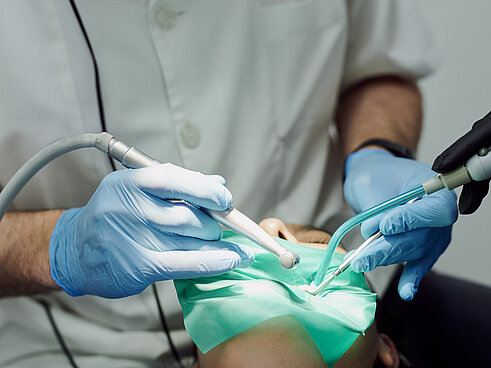
These systems can be used as portable and stationary devices. Emergency suction devices, for example, are portable units used in ambulances or medical emergency centers. They are compact, lightweight, and usually powered by a rechargeable battery. Stationary devices are professional vacuum systems mainly used in clinical settings like hospital operating rooms and wards, ICUs, doctor’s practices such as dental or ENT (ear, nose, throat) facilities, or in home care. They are larger and more powerful than portable devices and connected to a power outlet. By operating continuously, they are ready for use at any time during a procedure. Both portable and stationary devices must deliver a reliable and consistent suction power because even the smallest system interruption can impair visibility, prolong procedures, or jeopardize patient wellbeing.
Diaphragm Suction Pump: The Core Component in Medical Suction Devices
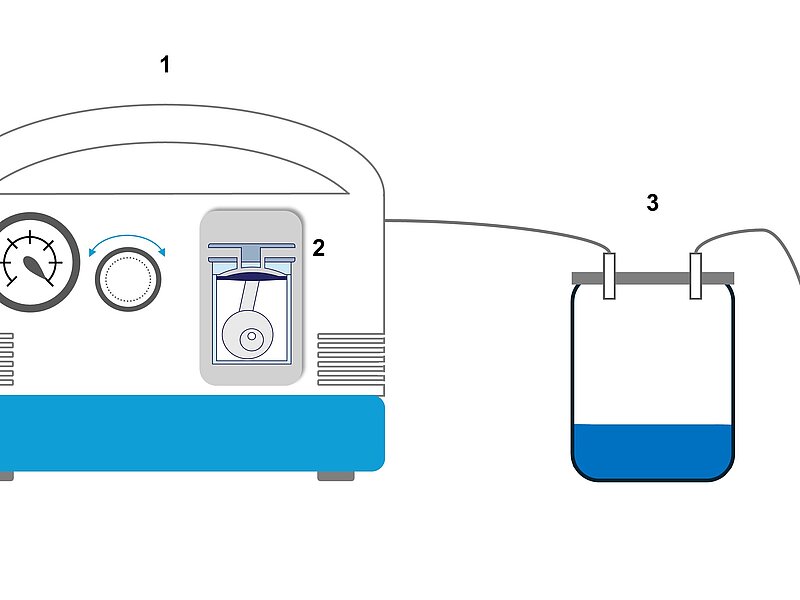
Diaphragm vacuum pumps are the essential component in portable and stationary medical suction devices (1). The pump is integrated into the device (2) and connected via tubes, valves, and filters to a sealed collection canister (3). The canister, in turn, is connected via a tubing system or hose to the suction instrument used on the patient. When the device is turned on, the diaphragm suction pump creates negative pressure in the canister. Because of the applied vacuum, air flows through the suction instrument and pulls the fluids along with it into the canister.
Learn more about vacuum-over-liquid transfer
The canister safely contains the fluids and keeps them separate from the airflow. This prevents liquids from reaching the pump and ensures reliable operation of the suction system. If the canister is full and not emptied or replaced, a hydrophobic filter prevents liquid from entering the pump. Since only filtered air flows through the pump, steady suction is ensured during the devices’ operation. The pump must meet the highest standards of reliability, precision, and performance because if it malfunctions, the entire suction system becomes unusable.
KNF’s Vacuum Pump Portfolio Powers Portable and Stationary Suction Devices
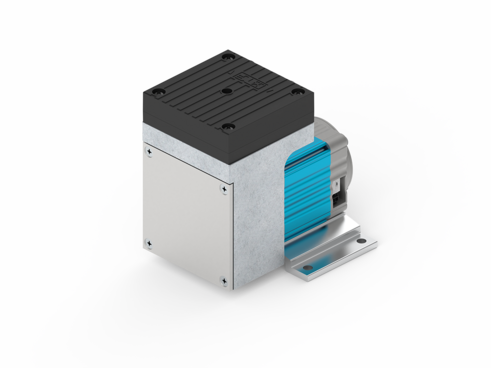
KNF offers versatile diaphragm pump solutions for clinical suction devices. With specific and adjustable flow rates, they are suitable for different medical needs. For portable units, single-head pumps like the N 838 are a strong choice. It offers a maximum ultimate vacuum of 100 mbar (abs.) and a maximum flow rate of 34 l/min. The diaphragm ensures leak-tightness to reinforce the strong, stable vacuum levels generated by the pump. Its pump head is made of PPS and the diaphragm from EPDM, the ideal material combination for use in medical suction devices.

Double-headed diaphragm pumps like the N 838.1.2 are the ideal solution for stationary suction devices. The pump delivers a maximum flow rate of 60 l/min and a maximum ultimate vacuum of 90 mbar (abs.). Like all KNF medical suction pumps, it is equipped with a brushless DC motor (BLDC). With its parameterizable speed control, the motor can be adapted to a wide range of operating points and performance requirements. Integrated safety functions provide additional protection and contribute to reliable operation. The BLDC motor also ensures a long service life, which is essential for continuously running suction systems.

Intelligent Pressure Control Feature Gives Manufacturers a Competitive Edge
For enhanced performance control KNF offers diaphragm pumps with intelligent features. The MGP 75 series with Pressure Control provides significant advantages for medical device manufacturers. The closed-loop system maintains pressure stability even if conditions change. This allows manufacturers to design highly reliable and efficient suction devices. Depending on the configuration, the pump achieves a maximum vacuum of 140 mbar (abs.), a maximum flow rate of 72 l/min, and pressure up to 0.4 bar (rel.). Equipped with an advanced brushless DC motor, the pump offers a long service life and enhances energy efficiency. Additionally, these intelligent suction pumps operate very quietly and with low vibration.